
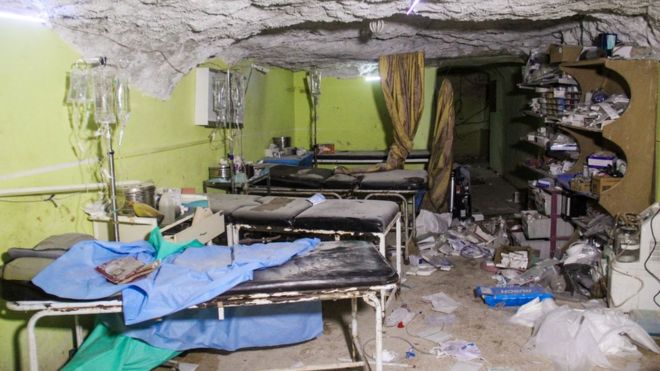
 Witnesses said clinics treating the wounded were subject to air strikes
Russia has clashed with other world
powers at the UN Security Council in New York on the chemical weapons
deaths in northern Syria.
Moscow's suggestions that civilians were poisoned by rebel weapons on the ground have been widely rejected.
The
UK's foreign secretary, a rebel commander and a weapons expert all said
the evidence pointed to an attack by Syrian government forces.
The issue is also overshadowing an aid conference on Syria in Brussels.
Seventy
donor nations are discussing aid efforts in the war-ravaged country.
The UN's Emergency Relief Coordinator, Stephen O'Brien, said details of
new pledges would be released later on Wednesday.
According
to UK-based monitoring group the Syrian Observatory for Human Rights,
20 children and 52 adults were killed in the chemical incident in Khan
Sheikhoun, Idlib province, on Tuesday.
Opening the Security
Council meeting, UN High Representative for Disarmament Affairs Kim
Won-soo said that, if confirmed, this would be biggest chemical weapons
attack in Syria since Ghouta in August 2013, when hundreds of people were killed in rebel-held suburbs of Damascus.
What happened?
Footage
from Khan Sheikhoun following the incident on Tuesday showed civilians,
many of them children, choking and foaming at the mouth.
Witnesses say clinics treating the injured were then targeted by air strikes.
- Aftermath of attack in pictures (Warning: graphic images)
- The spectre of nerve agents in Syria - again
- Media outrage at Syria chemical attack
Some of the victims were treated across the border in Turkey.
One woman in hospital said: "We were affected by the gas. We couldn't
stand up. I felt dizzy and sick. I suffer from shortness of breath. I
couldn't breathe."
The World Health Organization said some of the victims had symptoms consistent with exposure to nerve agents.
A
team from medical charity MSF treating victims in Idlib found patients'
symptoms were "consistent with exposure to a neurotoxic agent such as
sarin gas", the charity said in a statement.
Sonia
Khush, Syria director of the charity Save the Children, said victims
had travelled far and wide to get treatment, making it difficult to
estimate how many had been affected.
What do the Russians say?
The
government of Syrian President Bashar al-Assad, which is backed by
Russia, denies its forces launched a chemical weapons attack.
Russia
has acknowledged that Syrian planes did attack Khan Sheikhoun but it
says the aircraft struck a depot producing chemical weapons, for use by
militants in Iraq.
"Yesterday [Tuesday], from 11:30am to 12:30pm
local time, Syrian aviation made a strike on a large terrorist
ammunition depot and a concentration of military hardware in the eastern
outskirts of Khan Sheikhoun town," Russian defence ministry spokesman
Igor Konoshenkov said.
"On the territory of the depot there were workshops which produced chemical warfare munitions."
What did they say at the UN?
Matthew
Rycroft, the UK's ambassador to the UN, told the Security Council that
Mr Assad had "humiliated" Russia by "making a mockery" of the peace
process it had brokered with some rebel groups.
He suggested Russia was "defending the indefensible" by supporting the Syrian government in its actions.
Russia's deputy ambassador to the UN, Vladimir
Safronkov, hit back by accusing the UK of being "obsessed" with
overthrowing President Assad instead of seeking peace.
He said
his country - which can veto any UN Security Council resolution - saw no
need for a new resolution and called for a "full, objective"
international investigation. Much of the video evidence of the attack
had, he argued, been "staged".
The US ambassador to the UN, Nikki Haley, said Syrian chemical attacks would continue if nothing was done.
"Time and time again Russia uses the same false narrative to deflect attention from their ally in Damascus," she said.
"How many more children have to die before Russia cares?" she asked.
France's
UN envoy, Francois Delattre, called on Russia to put greater pressure
on the Syrian government but added that the world needed an "America
that is seriously committed to a solution in Syria and that puts all its
weight behind it".
What do others say to the Russian version?
Hasan
Haj Ali, commander of the Free Idlib Army rebel group, told Reuters
news agency: "Everyone saw the plane while it was bombing with gas."
Local
journalists say there are no military positions in the town itself but
an array of broadly aligned rebel groups controlling the area
surrounding it.
Critics of the Russian statement say reports of the release of gas came hours before the times stated by Mr Konoshenkov.
A chemical weapons expert, Col Hamish de Bretton-Gordon, told the BBC that the Russian version of events was "pretty fanciful".
The
idea that a nerve gas like Sarin could spread after a weapons
manufacturing process had been bombed was "unsustainable", he added.
US President Donald Trump called the deaths a "terrible affront to humanity".
Has Assad used chemical weapons before?
The Syrian government was accused by Western powers of firing rockets filled with Sarin at Ghouta.
President Assad denied the charge, blaming rebel fighters, but he did subsequently agree to destroy Syria's chemical arsenal.
Despite
that, the Organisation for the Prohibition of Chemical Weapons has
continued to document the use of toxic chemicals in attacks in Syria.
How bloody is Syria's civil war?
More than 250,000 people have been killed and, after more than six years, no political solution to the fighting is in sight.
Nearly five million Syrians have fled the country and more than six million are internally displaced, the UN says.
"This
is the most complex and the most violent conflict in our times," EU
foreign policy chief Federica Mogherini said at the conference in
Brussels.
Post a Comment